

Reactivation
Your next best client already bought from you once.
Somewhere in your database is a client whose fixed rate expires in eight weeks, a policy thirty days from renewal, a quote that went quiet in March. Every one of those is a date, and every date is a reason to ring. Optiphone makes the call on the day it becomes worth making, to everyone it applies to, in a voice that sounds like your office.
"Hi Mark, it's Ruby calling from Dan's office. Your fixed rate wraps up in about eight weeks and it'd roll onto the variable rate from there. Did you want him to run the numbers before that happens?"
Your clients, your script, your timing.
One trigger, one script, applied to everyone who crosses it.
A reactivation campaign is a date, a list and a conversation. You decide the first, we handle the other two, and nobody has to remember to make the call.
You name the trigger
A fixed rate eight weeks from expiry. A policy ninety days from renewal. A service twelve months since the last one. You decide what event means a call is due, once, and it applies to everyone who crosses it from then on.
We watch the date, or you hand us the list
Where we can read the date out of a system you already run, the call fires on its own and nobody has to remember. Where we cannot, you hand over the list of contacts that have crossed the trigger, however you already track them. Both are normal.
The call goes out while there is still time to act
Not a month after the rate reverted. Not when someone in the office finally works through the spreadsheet. The agent calls on the day you chose, in your voice, with the reason for the call in the first sentence.
What happens on a yes is your call
Book it straight into the diary, transfer the warm ones through to whoever is free, or capture everything and have a human ring back. You pick per campaign. Most businesses start with capture and callback so they keep control of the diary.
The call is obvious. The date is the hard part.
Nobody disagrees that these calls should happen. They do not happen because the date passes quietly and the list is long. Here is what businesses hand us first.
A fixed rate approaching its rollover
The client fixed two years ago and has not thought about it since. The rate expires and the loan reverts to whatever the lender decides. A call eight weeks out is the difference between a review and a renewal somewhere else.
A policy coming up for renewal
Renewal dates are the one moment your client is guaranteed to be thinking about the product. Being the first voice they hear that month is worth more than any email in a crowded inbox.
A service that has quietly lapsed
Twelve months since the last pool service, the last system clean, the last inspection. The customer has not left, they have just not booked. Nobody is chasing them because nobody owns the job of chasing them.
A quote that never closed
It went out at thirty days, sixty, ninety, and died without a reason. The agent rings to find out which it was: gone to someone else, or simply stalled. One of those two answers is worth money.
An appraisal anniversary or a lease expiry
Past vendors, past appraisals, leases coming up for renewal. Agencies sit on years of these and work them when someone has a quiet week. This turns a quiet week into a date in the calendar.
If your own trigger is not on this list, it is very likely buildable. The first conversation is about which of your dated events leaks the most money, not which one is the most interesting to build.
Going back to customers you have already had is not a hunch.
We have not run this system long enough to publish our own number, and we are not going to invent one. What exists is peer-reviewed research, and it is worth reading with its limits stated.
In 2015 the Journal of Marketing published a study of customer win-back by V. Kumar, Yashoda Bhagwat and Xi (Alan) Zhang of Georgia State University, built on eight years of customer records from a United States telecommunications company, covering 2006 to 2014.
Its conclusion was that customers who have left can be won back profitably, that win-back campaigns are worth the time and effort they cost, and that whether someone comes back is predictable from how they behaved the first time and why they left. The strongest results came from offers that combined something of value with a genuine fix for the reason they walked.
What it does not say. It is a study of win-back offers in telecommunications, not of phone calls, and not of Australian trades, finance or real estate. It does not measure reactivation by voice and it is not our result. We cite it because it is the closest thing to hard evidence that going back to people who have already dealt with you pays, and because the alternative is a number off a marketing blog with no source behind it.
Every call ends with an answer, not a guess.
Your office gets the outcome of every call, the reason behind it in the customer's own words, and the full transcript.
Booked, or straight through to your team
Where you have enabled it, the agent takes the appointment on the call or transfers the warm ones through while the person is still on the line. Where you have not, it captures everything and flags it hot.
Interested, but not yet
Plenty of people are not saying no, they are saying not this month. The agent captures the reason and the date they asked to be called back on, so the next touch is a diary entry rather than a guess.
Not interested, and why
A no with a reason attached is useful. Already refinanced, already booked elsewhere, sold the property, changed circumstances. That comes back in their own words, not as a blank field.
Do not call again
Anyone who asks not to be contacted is recorded as such and is not called again on any campaign. That is handled on the call, not left for your team to remember.
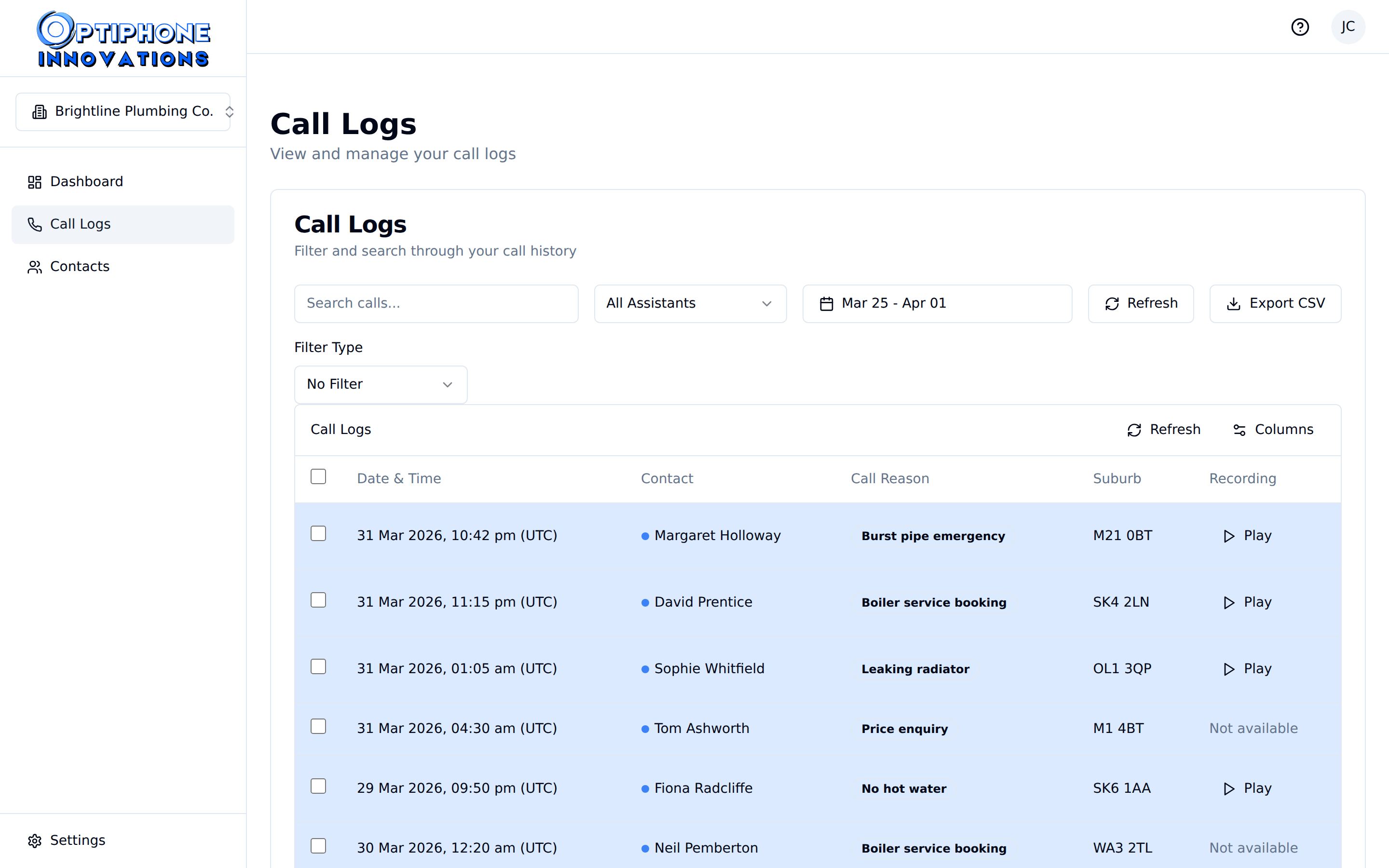
The same call log every other Optiphone system uses. Every contact called, timestamped, searchable, with the outcome and the transcript sitting behind it. A campaign you cannot read the results of is a campaign you cannot improve.
Outbound, with the rules written down.
This is the first question every serious business asks, and it should be. Outbound calling in Australia has rules about who you may call, when, and what the call has to tell them. Ours are published, not implied.
It identifies itself, every call
The agent says who is calling and which business it is calling on behalf of, in the first sentence. No withheld numbers, no pretending to be something it is not, and every call is recorded and transcribed.
Permitted hours, your time zone
Calls run inside the calling hours set out in our outbound terms, read in the time zone of the person being called rather than the one your office sits in. A trigger that falls on a Sunday waits.
Opt-outs honoured on the spot
If someone asks to be taken off the list, the agent confirms it on the call and the contact is suppressed across every campaign you run with us, not just the one that reached them.
Your list, your relationship
These are your contacts, people who have dealt with your business before. We do not supply lists, buy data, or call anyone you have not given us. Which of your contacts you may lawfully have us call is set out in the outbound terms, and you confirm it before a campaign runs.
The full rules every outbound campaign runs under, including permitted calling hours, mandatory call conduct, prohibited uses and where responsibility sits between you and us, are set out in our outbound calling terms. Read them before you book. They are deliberately specific.
Nothing on this page is legal advice. You know your own client relationships and your own industry's rules better than we do, and the terms set out which of those obligations stay yours.
Your database stays your database.
Optiphone does not become the system of record for your clients. It reads the trigger, makes the call, and writes the answer back.
Contacts sync both ways with the tools Optiphone already connects to, so the person the agent rings matches the record in your system and the outcome lands back where your team will see it. Where the trigger date lives somewhere we can read, the campaign fires on its own. Where it does not, you hand us the list and nothing about how you track clients has to change. See what each integration syncs, or tell us what you run and we will tell you which half of that applies to you.
Trusted by Aussie Businesses
What Our Customers Say
Real feedback from real business owners using Optiphone every day.
“Excellent product, this is a life saver, especially in tax season - when we are too busy to answer every call.”
Amanda Amey
MQ Accountants
“Dylan has been nothing but Fantastic. Owning a business myself, I know the difficulties of staying on top of things, trying to be everywhere at once & slowly loosing my mind. Dylan fixes this & he fixes it well. Highly Recommend!”
Ty Grech
Junk Gents
“Optiphone has absolutely changed the game for us. Managing calls was an absolute nightmare while being on the tools and often not even having the schedule on anything else. I used to have to run to the car to get it. We don't have emergencies often but getting that call every now and then helps our cashflow so much, I used to miss most of those.”
Tristan Amey
Poolzone
Common questions, straight answers.
More questions? See the full FAQ or email [email protected]