

Every feature, in detail
The Calls Your Database Has Been Owed For Years.
A fixed rate eight weeks from rollover. A policy thirty days from renewal. A service twelve months overdue. A quote that went quiet in March. Every one of those is a date, and a date is a reason to ring. Optiphone makes the call on the day it becomes worth making, to everyone it applies to.
What the agent actually says
"Hi Mark, it's Ruby calling from Dan's office. Your fixed rate wraps up in about eight weeks and it'd roll onto the variable rate from there. Did you want him to run the numbers before that happens?"
The name, the date, the consequence, and an offer. Four things, in the first breath. It is the opposite of a cold call, because the reason for the call is the first thing the client hears and it is a reason they care about.
The Date Stops Being Somebody's Job To Remember.
A reactivation call is only worth anything on the right day, and the right day is the thing that always slips. Set the trigger once and every contact who crosses it gets called, whether or not anyone had a spare afternoon that week.
Automatic Where We Can Read It, Your List Where We Cannot.
Where the trigger date sits in a system we connect to, the campaign fires on its own. Where it does not, you hand over the contacts that have crossed the trigger, however you already track them. Most businesses end up using both, and nothing about how you keep records has to change.
It Opens With The Reason, Not A Pitch.
The client's name, the date that is about to pass, and what it means for them. The call sounds like a business they already deal with doing them a favour, because that is what it is. No cold opening, no discovery script, no pretending this is a courtesy call.
Book It, Transfer It, Or Capture It. Your Choice.
Per campaign, you decide what a yes triggers: an appointment taken on the call, a live transfer to whoever is free, or a full capture flagged for a human to ring back. Booking is off by default, because most owners want to keep control of the diary.
Run More Than One Trigger At Once.
Rollovers, renewals, lapsed services and dead quotes can each run as their own campaign with its own script and its own reporting. A contact who opts out of one is suppressed across all of them, so the campaigns cannot talk over each other.
You Approve Every Script.
Same rule as every Optiphone system. Nothing reaches a client's phone until you have signed off the wording, the tone and the trigger. Changes are a request to our team, not a setting you have to find yourself.
The triggers
Nobody Argues The Call Should Happen
These calls do not get made because the date passes quietly and the list is long, not because anyone thinks they are a bad idea. Here is what businesses hand us first.
Mortgage broking and finance
Fixed rate approaching rollover
The client fixed two years ago and has not thought about it since. The fixed term ends and the loan reverts to whatever the lender decides it reverts to. A call eight weeks out is the difference between a review booked with you and a refinance arranged by someone else.
Insurance, broking, subscription services
Policy or contract renewal
Renewal is the one moment in the year your client is guaranteed to be thinking about the product. Being the first voice they hear that month is worth more than any email sitting in a crowded inbox.
Trades and home services
A service that has quietly lapsed
Twelve months since the last pool service, system clean, safety inspection or test and tag. The customer has not left, they have simply not booked, and nobody is chasing them because chasing them is nobody's actual job.
Any business that quotes
A quote that never closed
It went out at thirty days, sixty, ninety, and died without a reason attached. The agent rings to establish which of the two it was: gone elsewhere, or simply stalled. Knowing which is worth money, and a dead quote with a reason on it also tells you something about your pricing.
Real estate and property management
Appraisal anniversary and lease expiry
Past vendors, past appraisals, leases coming up for renewal. Agencies sit on years of these and work them when somebody has a quiet week. This turns a quiet week into a date in the calendar, every month, without an agent having to feel like a telemarketer.
If your own trigger is not on this list, it is very likely buildable. The first conversation is about which of your dated events leaks the most money, not which one is the most interesting to build.
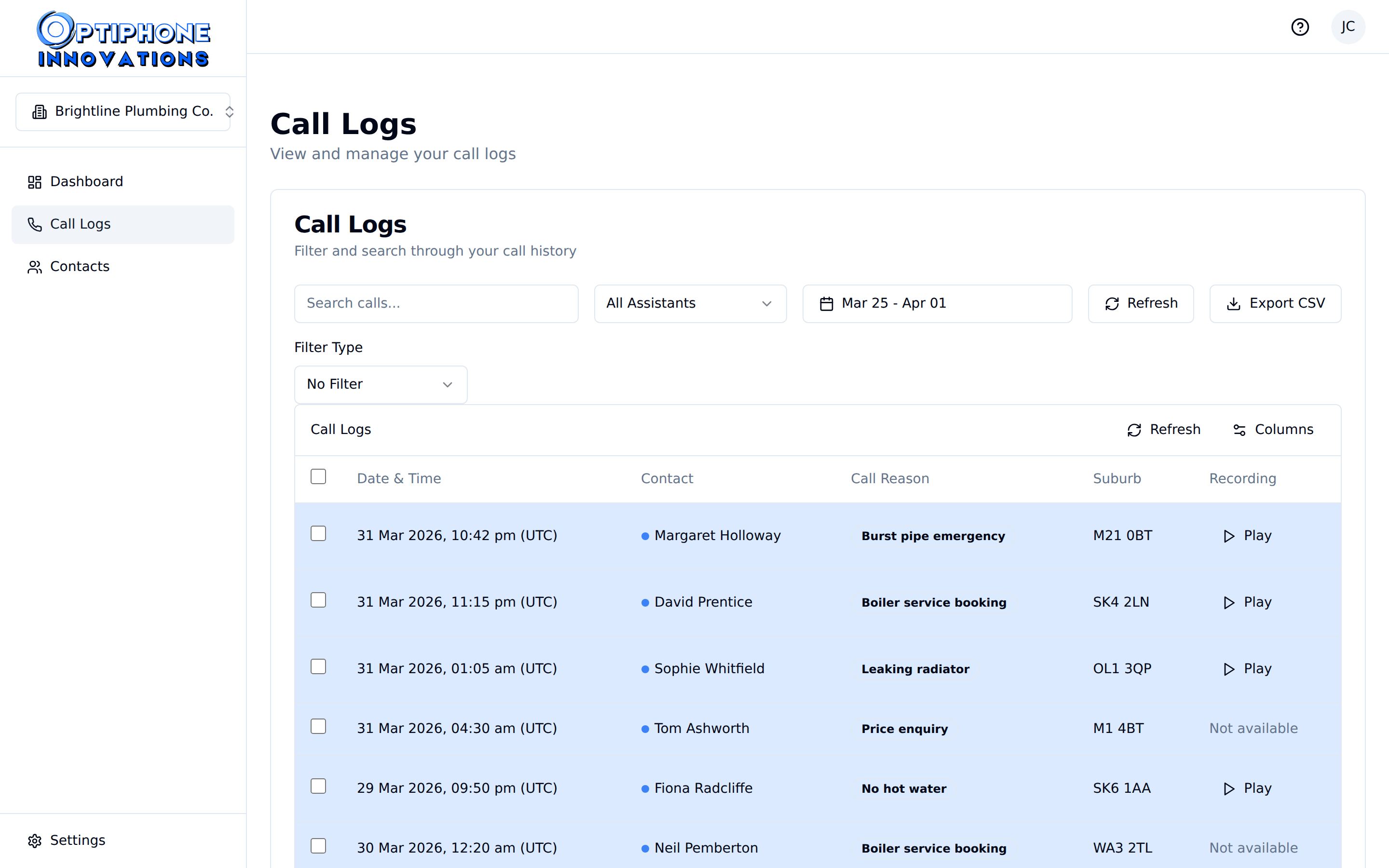
Full visibility
Every Contact Called, Every Outcome Sorted
The same call log every other Optiphone system uses. See who was called, when, and what happened, across the whole campaign. A reactivation campaign you cannot read the results of is a campaign you cannot improve.
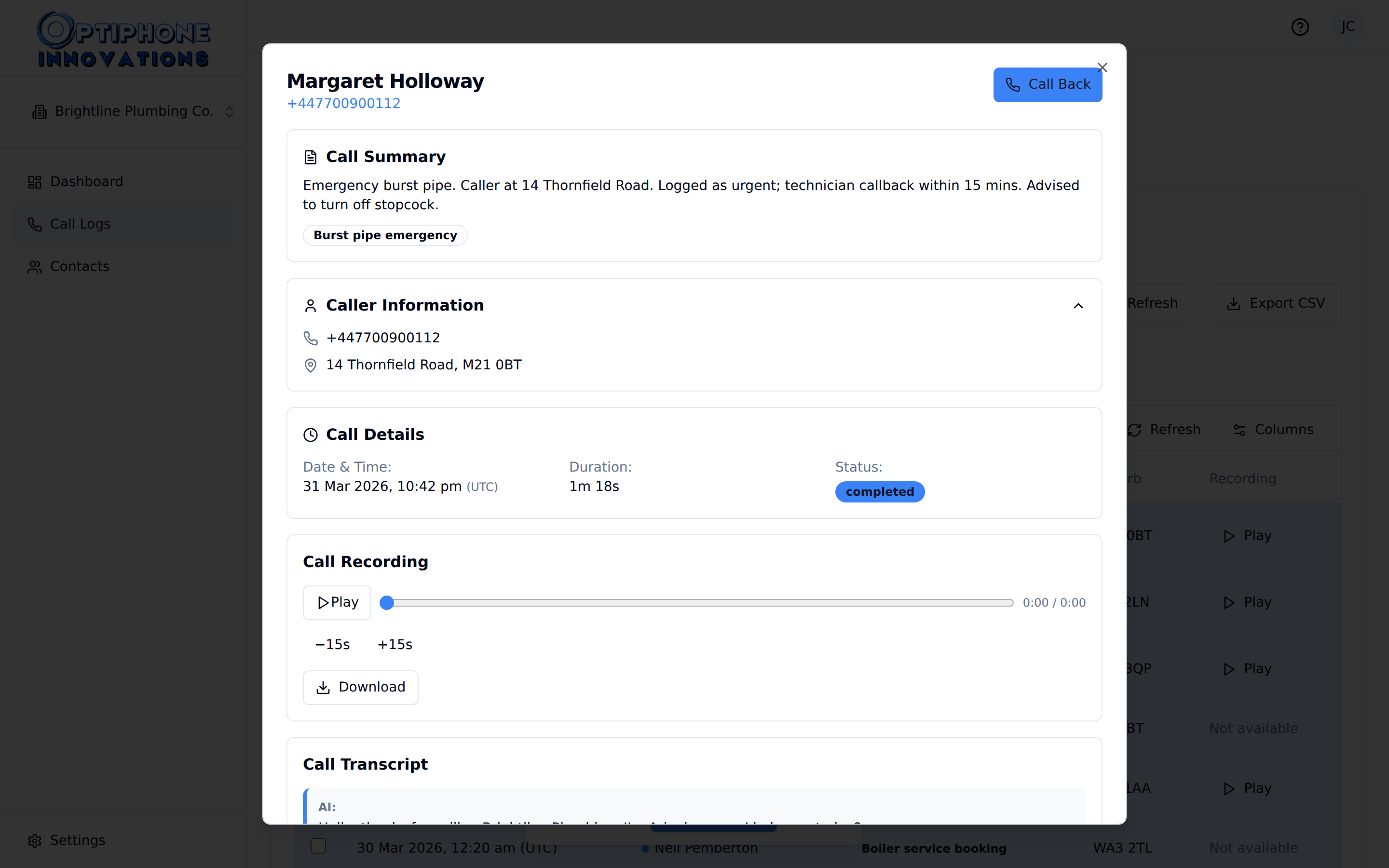
The transcript
Read Exactly What Was Said
Every call comes with a full transcript and recording. When a client says they have already refinanced, or that they are waiting until after Christmas, you see their words rather than a secondhand summary, and you can decide whether the trigger timing was right.
What comes back to you
Four Outcomes, Sorted For You
Booked or transferred
Where you have enabled it, the appointment is taken on the call or the warm ones are transferred through while the person is still on the line. Where you have not, everything the team needs is captured and flagged hot.
Interested, not yet
Most people are not saying no, they are saying not this month. The reason and the date they asked to be called back on both come back, so the next touch is a diary entry rather than a guess.
Not interested, with the reason
Already refinanced, already booked elsewhere, sold the property, circumstances changed. In their own words, not as a blank field. Across a campaign those reasons are the most useful thing it produces.
Do not call again
Recorded on the call and suppressed across every campaign you run with us. Your team does not have to remember it, and no later campaign can reach that contact by accident.
And the reasons, which are the real output
One call tells you about one client. A campaign tells you about your book. When forty people give you a reason for not moving, you learn whether your timing is wrong, your offer is wrong, or your competitor got there first. That is not something an email open rate can tell you.
The evidence, cited accurately
Going Back To Customers You Have Already Had Is Not A Hunch
We have not run this system long enough to publish our own number, and we are not going to invent one. What does exist is peer-reviewed research. In 2015 the Journal of Marketing published a study of customer win-back by V. Kumar, Yashoda Bhagwat and Xi (Alan) Zhang of Georgia State University, built on eight years of customer records from a United States telecommunications company covering 2006 to 2014.
Its conclusion was that customers who have left can be won back profitably, that win-back campaigns are worth the time and effort they cost, and that whether a particular person comes back is predictable from how they behaved the first time around and why they left. The strongest results came from offers that paired something of value with a genuine fix for the reason they walked in the first place.
What it does not say. It is a study of win-back offers in telecommunications, not of phone calls, and not of Australian finance, trades or real estate. It does not measure reactivation by voice, and it is not our result. We cite it because it is the closest thing to hard evidence that going back to people who have already dealt with you pays, and because the alternative is a number off a marketing blog with nothing behind it. When we have our own number from a client campaign, it will replace this section.
Done properly
Outbound, With The Rules Written Down
This is the first question a serious business asks, and it should be. Outbound calling in Australia has rules about who may be called, when, and what the call has to tell them. Ours are published, not implied.
Identifies itself on every call
Who is calling and which business it is calling on behalf of, in the first sentence. No withheld numbers, no implying it is something it is not, and every call recorded and transcribed.
Permitted hours, in the contact's time zone
Calls run inside the hours set out in the outbound calling terms, read in the time zone of the person being called rather than the one your office sits in. A trigger that lands on a Sunday waits.
Opt-outs honoured immediately
Confirmed on the call and applied across every campaign you run with us, not just the one that reached them. There is no queue and no manual step for your team.
Your list, your relationship
We do not supply lists, buy data, or call anyone you have not given us. Which of your own contacts you may lawfully have us call is set out in the outbound calling terms, and you confirm it before a campaign goes live.
Read the outbound terms before you book
Permitted calling hours, mandatory call conduct, prohibited uses, follow-up messages, and exactly where responsibility sits between you and us. They are deliberately specific. Nothing on this page is legal advice: you know your own client relationships and your own industry's rules better than we do, and the terms set out which of those obligations stay yours.
Fits what you already run
Your Database Stays Your Database
Optiphone does not become the system of record for your clients. Contacts sync both ways with the tools it already connects to, so the person the agent rings matches the record in your system and the outcome lands back where your team will see it. Where the trigger date lives somewhere we can read, the campaign fires on its own. Where it does not, you hand us the list and nothing about how you track clients changes.
How it works
From Trigger To Answer
Scoped once, then it runs on the rules you agreed, and every one of them can be changed later.
We work out which dated event in your business is actually worth calling on, how many contacts cross it in a month, and what the call has to achieve. If the trigger you came in for is not the one leaking the most money, we will say so.
- The trigger event and how far ahead of it to call
- Whether we can read the date from a system you run, or you supply the list
- What a yes should do: book, transfer, or capture for callback
- Attempt limits, time between tries, and whether to leave a message
- Opening line, tone and the full script signed off by you
From that point the calls happen on the day, to everyone who crossed the trigger. Nobody has to remember, and no contact gets skipped because the month got busy.
- Calls placed inside permitted hours, in the contact's time zone
- Every outcome sorted: booked, not yet, not interested, do not call
- Full transcript and recording delivered for every call
- Opt-outs suppressed across every campaign automatically
The reasons that come back from the first run are the most valuable output of the campaign. They tell you whether the trigger timing is right, whether the offer lands, and what your clients are actually doing instead.
- Review the outcomes and the reasons across the whole campaign
- Script, timing and trigger adjustments handled by our team
- Add further triggers as their own campaigns once the first one proves out
What it costs
Scoped With You, Then Quoted
There is no rate card for this one, because no two campaigns are the same size. The cost moves with how many contacts cross your trigger, how often it fires, what the agent has to do when someone says yes, and which systems it has to read from and write back into. Book a call, tell us which dated event you want called on, and we will scope it and quote it in writing. If it is not the conversation worth systemising first in your business, we will tell you that too.
Ready?
Put A Date On The Calls Nobody Is Making.
Book a consultation and we will work out which trigger in your business is worth calling on first, what the call should say, and what it looks like to run.